A student in Year 5 or Grade 4 can discuss a character’s motivation, explain an inference, or write a thoughtful paragraph—and still stumble over a word such as bright, movement, or uncertain. When that happens, we know the issue is not a lack of ideas. This is why explicit instruction and decoding practice is a key part of phonics for older students.
The tricky part is finding practice that feels suitable for an older reader. A worksheet covered in cartoon animals and babyish sentences can send the message, “This is for little kids,” even when the underlying skill is exactly what the student needs. Phonics for older students should be direct and carefully sequenced, but it should also respect their age, interests, vocabulary, and growing independence.
Here are several ways to make that practice more engaging without disguising the teaching point.
Start with the skill, not the theme
Age-appropriate phonics begins with a clear understanding of what the student needs to learn. Before choosing an activity, identify the specific sound-spelling pattern or decoding behavior to practice.
For example, a student may need support with:
- alternative spellings for the long /a/ sound, such as ai, ay, a-e, and eigh
- vowel teams in words such as cautious, explain, and approach
- multisyllabic words and syllable division
- prefixes, suffixes, and base words
- reading words with less common grapheme-phoneme correspondences
Once the focus is clear, you can use an age-respectful context around it. A lesson on the /shun/ ending might use words such as invention, discussion, permission, and expansion rather than a list of very simple words. The decoding task remains explicit, but the vocabulary feels more connected to the reading students encounter in upper elementary and middle school.

It is also helpful to separate challenge from confusion. Phonics for older students doesn’t mean that they need a bunch of difficult words. Include a manageable number of target words, provide a model when necessary, and leave enough mental space for students to notice the pattern.
Use comics and visual storytelling as a bridge
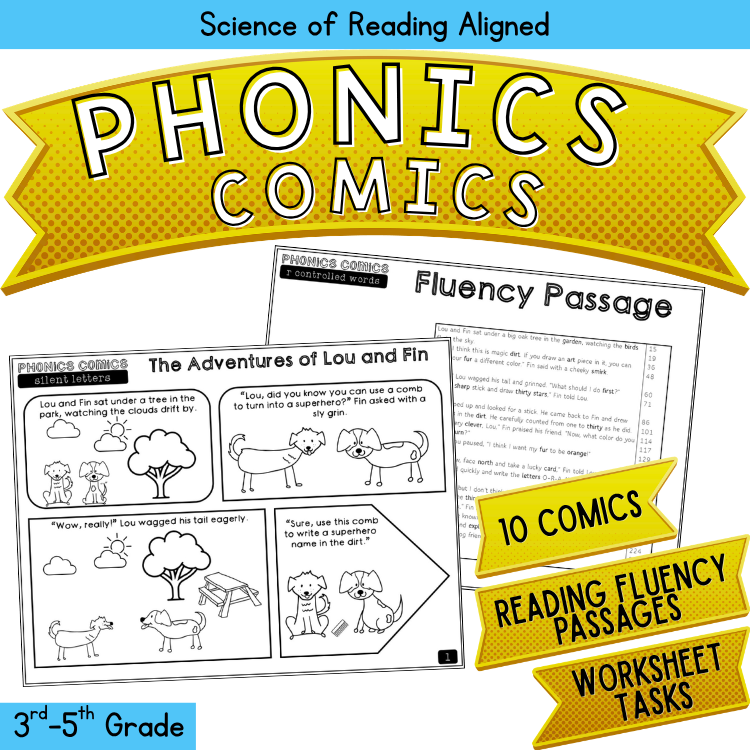
Comics can be a useful format for older readers because they offer a genuine reason to read short stretches of text. Speech bubbles, captions, sound effects, and brief scenes can make decoding practice feel like part of a story rather than an isolated exercise.
You might create a four-panel comic that includes several words with the target pattern. If the focus is the spelling pattern igh, the characters might be trying to find a lost kite at night. The dialogue could include words such as light, right, flight, and might. Students can first read the comic for meaning, then revisit it to find and sort the target words.

A simple routine could look like this:
1. Preview the target spelling pattern.
2. Read the comic together, encouraging students to attempt unfamiliar words.
3. Ask students to circle or record words containing the pattern.
4. Discuss how the words sound and what they mean.
5. Let students add one final speech bubble using another target word.
The visual format is not just decoration. It gives students context, supports comprehension, and creates a small amount of purposeful reading. Keep the artwork clean and the humor appropriate for the age group. A comic about a mysterious locker, a gaming tournament, a science experiment, or an unfortunate lunchtime event will usually feel more respectful than a page of smiling animals practicing isolated words.
Build practice around short, interesting texts
Short texts are particularly helpful for phonics for older students because they allow students to apply a pattern without becoming overwhelmed by a whole chapter. They can also be written with mature topics and natural language.

A short passage about an unusual invention, a sports challenge, a survival decision, or a strange animal can contain plenty of decoding opportunities. The passage does not need to include every possible target word. In fact, overly crowded texts can sound unnatural and make comprehension harder.
Try a three-part approach:
- Before reading, introduce two or three important words and examine their parts.
- During reading, ask students to mark words they decode using the focus pattern.
- After reading, discuss the text first, then return to one or two words for closer analysis.

For example, after reading a short text about a desert expedition, students might discuss why the explorer changed direction. Then they could examine words such as temperature, direction, and carefully. This keeps phonics connected to meaning. Students are practicing decoding because they are reading to understand something, not simply because a list told them to.
Add games with a clear literacy purpose
Games can lift the energy of a phonics session, but the game should serve the reading goal. Otherwise, students may become excellent at collecting points while doing very little decoding.
A word sort can become a quick detective challenge. Give pairs a set of words and ask them to sort the words according to a spelling pattern, syllable type, or suffix. Students then explain one of their decisions. A board game might require a player to read a word, identify its base word, or use it in a meaningful sentence before moving forward.

For a lesson on prefixes, provide cards with words such as disagree, preview, impossible, and reappear. Students can match each word to its prefix and base word, explain how the prefix changes the meaning, and then use the word in context. For multisyllabic words, challenge students to find the word that does not belong and explain why. The discussion is often more valuable than the speed of the game.
Keep competition optional and avoid putting struggling readers on the spot. Pair work, team challenges, and private response cards can make participation feel safer. A game should give students more chances to read successfully, not turn every mistake into a public event.
Teach morphology alongside phonics
As teachers, you can strengthen phonics for older students by connecting sounds and spelling to morphology. Prefixes, suffixes, and base words help students approach longer words with a plan. They also support vocabulary and spelling, so the work feels relevant beyond the intervention lesson.
Suppose the target word is prediction. Students can identify predict as the base word and -ion as a suffix. They can notice that the word is built from meaningful parts while also attending to the sounds and spellings within those parts. Other useful word families might include:
- inform, information, informative
- act, action, active, react
- help, helpful, helpless
- courage, courageous, encourage

Morphology does not replace phonics. Students still need to decode the word accurately. Instead, it gives them another useful route into complex words. Ask questions such as, “What part do you recognize?” “What does that part mean?” and “How does the pronunciation change when the word changes?”
This kind of word study can feel much more age-appropriate than practicing only short, highly regular words, especially when the examples come from science, history, novels, or students own writing.
Make the presentation respectful and uncluttered
Sometimes the content is suitable, but the design gives it away as “baby work.” Older readers often respond better to clear layouts, purposeful illustrations, interesting facts, and choices in how they show understanding. That does not mean every page needs to look serious or resemble a textbook. It means the materials should look like they were made with the learner in mind.
Use readable fonts, enough white space, and instructions that do not talk down to students. Avoid presenting the same task in a dozen decorative boxes. A single well-designed page can provide word reading, a short text, and a meaningful follow-up without feeling crowded.

You can also offer small choices: read with a partner or quietly to the teacher, sort words on paper or digitally, write a sentence or record one aloud. Choice helps preserve dignity while keeping the practice focused.
Keep the goal visible—and celebrate growth
Older struggling readers may have become very good at hiding uncertainty. They might guess from the first letter, skip a word, or wait for someone else to read it. Make the decoding process visible and teach a routine they can use independently: look through the word, identify known parts, blend or read the syllables, and check whether the word makes sense.
Praise the strategy rather than making a fuss over every correct answer. Comments such as, “You noticed the suffix before you tried the whole word,” or, “You went back and checked that vowel team,” show students what successful reading looks like.
Phonics for older students does not need to be disguised. It needs to be purposeful, well matched to the learner, and presented without making the learner feel younger than they are. Comics, short texts, games, morphology, and thoughtful design can all help students practice essential skills while reading material that feels worth their time.
The most important shift is to keep the age of the reader in view while teaching the skill they have missed. When practice respects both, decoding becomes less of a source of embarrassment and more of a route towards confident, independent reading.