The timer starts, pencils move for a few seconds, and then someone raises a hand: “I’m done.” Another student stares at a blank page. A third announces, with complete confidence, that there is absolutely nothing else to write. If you have heard these in your classroom before, these writing stamina activities can help avoid it happening again.
As a teacher, you feel frustrated. As a student, they feel unsuccessful in writing. The reality is that students need to develop writing stamina. This is the ability to stay engaged with a writing task long enough to generate, develop, organize, and revise ideas.
Writing stamina does not appear simply because we tell students to write more. Like reading stamina, it develops gradually through purposeful practice, clear routines, and tasks that feel manageable.
The goal of introducing engaging writing stamina activities is to help students experience themselves as capable writers who can keep going when the first idea runs out.

Start with a realistic baseline
Before increasing writing time, find out what students can currently manage. Choose a low-pressure writing task, such as responding to a shared read-aloud, describing a memorable place, or explaining how to do something. Give students a short, clearly defined writing period and observe what happens.
Notice more than the number of words on the page. Look for patterns:
- Who gets started quickly?
- Who spends most of the time planning but never begins?
- Who stops when the first paragraph is finished?
- Who has ideas but struggles to organize them?
- Who needs frequent reassurance or teacher prompting?
This baseline helps you set a sensible starting point. If many students currently write for eight minutes, jumping immediately to twenty-five minutes may create frustration rather than stamina. Begin with a time or volume target that is challenging but reachable, then increase it gradually.
You might say, “Today, our goal is to stay with our writing for ten focused minutes. Your writing does not have to be perfect, and you do not have to finish the whole piece. Your job is to keep making useful decisions as a writer.”

Build writing stamina activities in small increments
One of the most effective writing stamina activities is simply practicing sustained writing for short, regular periods. A few minutes of focused writing several times a week is often more useful than an occasional long session that leaves everyone exhausted.
Try adding two or three minutes to the writing period every few days, depending on how students respond. Keep the increase flexible. If students are becoming dependent on countdowns, producing rushed work, or losing focus completely, hold the current time for a while instead of adding more.
A simple progression might look like this:
- Week 1: 8–10 minutes of focused writing
- Week 2: 10–12 minutes
- Week 3: 12–15 minutes
- Week 4: 15–18 minutes
Use a visible timer if it helps students understand the length of the session, but avoid making the timer the main event. The purpose is not to “beat” the clock. It is to help students gradually discover that they can remain engaged for longer than they first thought.

Teach students what to do when they get stuck
“Keep writing” is not a strategy. When students reach the end of their first thought, they need a small collection of moves they can use independently.
Create a class anchor chart called “What Writers Do When They’re Stuck.” Add ideas such as:
- Explain the idea in more detail.
- Add an example or short story.
- Describe what happened before or after.
- Ask and answer a question about the topic.
- Compare the subject with something else.
- Explain why the idea matters.
- Add what someone might think, say, or do.
- Reread the last sentence and continue from there.
Model these moves aloud. For example: “I have written that the school garden is useful. That is a general statement, so I could explain how students use it. I could add an example about measuring the plants or collecting vegetables.”
This kind of modeling shows students that experienced writers do not wait for a perfect idea to arrive. They stretch, explain, question, and connect their ideas.

Use short writing bursts with a clear purpose
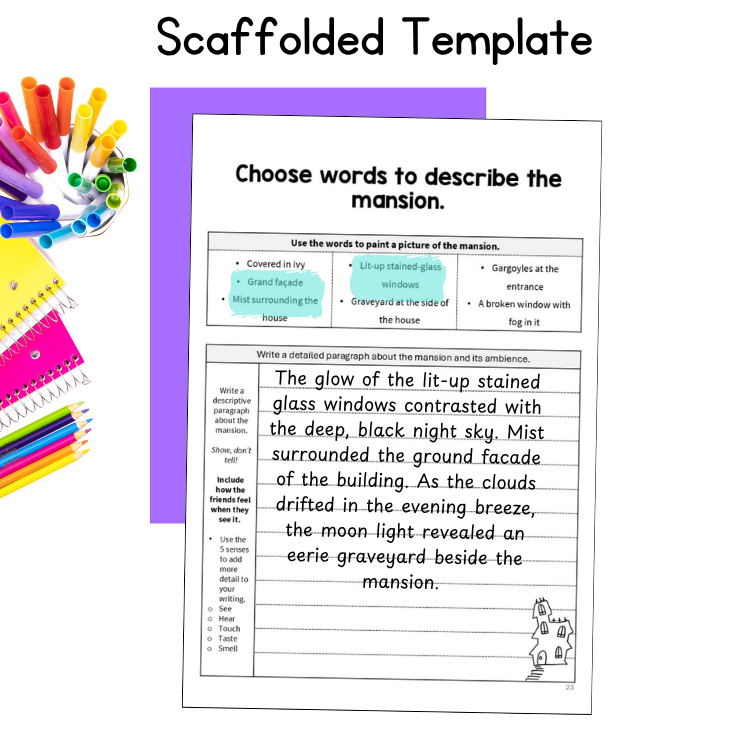
Long writing blocks can feel overwhelming, especially for students who are still developing fluency. Break a session into purposeful bursts of smaller writing stamina activities while keeping the overall writing time focused.
For example, during a personal narrative lesson, you might use this structure:
- Three minutes: jot sensory details about the setting
- Six minutes: draft the beginning of the event
- Two minutes: reread and underline the most important moment
- Six minutes: continue the draft by slowing down that moment
These are not unrelated worksheets or disconnected tasks. Each burst feeds into the same piece of writing. Students get a clear next step, which reduces the “What am I supposed to do now?” pause that can drain writing time.
You can also use a “write, pause, continue” routine. Students write for five minutes, briefly share one sentence or idea with a partner, and then return to their writing with a new direction. The pause should be short and purposeful; otherwise, the writing lesson can quietly turn into a social event with pencils nearby.

Make volume less important than meaningful development
Some students believe that being finished means reaching the bottom of the page. Others think good writing is measured only by length. Help them understand that writing stamina is connected to developing ideas, not producing a certain number of words at any cost.
Show two short examples: one that is long but repetitive, and one that is shorter but includes specific details, explanation, or reflection. Discuss which writer has developed the idea more effectively and why.
During writing conferences, ask questions that encourage elaboration:
- What would your reader want to know next?
- Can you show that instead of simply telling it?
- What is the most important part of this idea?
- Can you give a specific example?
- What were you thinking at that moment?
A student who adds a carefully chosen detail, explanation, or piece of dialogue is building writing volume in a meaningful way. This approach also prevents students from filling pages with repeated sentences just to satisfy a word target.

Offer choice within a clear structure
Choice can help students sustain attention, but unlimited choice can make getting started harder. Provide a small menu of options rather than asking students to invent everything from scratch.
For an informational writing session, students might choose one of three topics connected to current learning. For narrative writing, they could choose between a real event, an imagined event, or a story based on a photograph. You can also offer choices about how to plan: a quick sketch, a list of key events, a timeline, or a few labeled boxes.
Keep the writing expectations consistent while allowing the topic or planning method to vary. For example: “Whichever topic you choose, your piece should include a clear focus, specific details, and an ending that leaves the reader with something to think about.”
When students have some ownership, they are more likely to make decisions and continue working, rather than waiting for the teacher to supply every next sentence.

Celebrate persistence and teach reflection
At the end of a writing session, spend a minute reflecting on the process. Ask students to complete one of these sentence stems:
- Today I kept going when…
- A strategy that helped me was…
- Next time I get stuck, I will…
- One part I developed was…
You can also invite students to mark a small stamina tracker with the date, writing time, and one strategy they used. Keep the emphasis on growth and independence, not competition. A student who moved from writing for five minutes to writing productively for ten minutes has made important progress, even if another student filled several pages.
Writing stamina activities work best when they are regular, gradual, and connected to authentic writing. Give students manageable stretches of time, teach them how to respond to difficulty, and show them that strong writing grows through rereading and developing ideas. With patient routines, “I’m done” can gradually become, “I have one more thing to add.”


