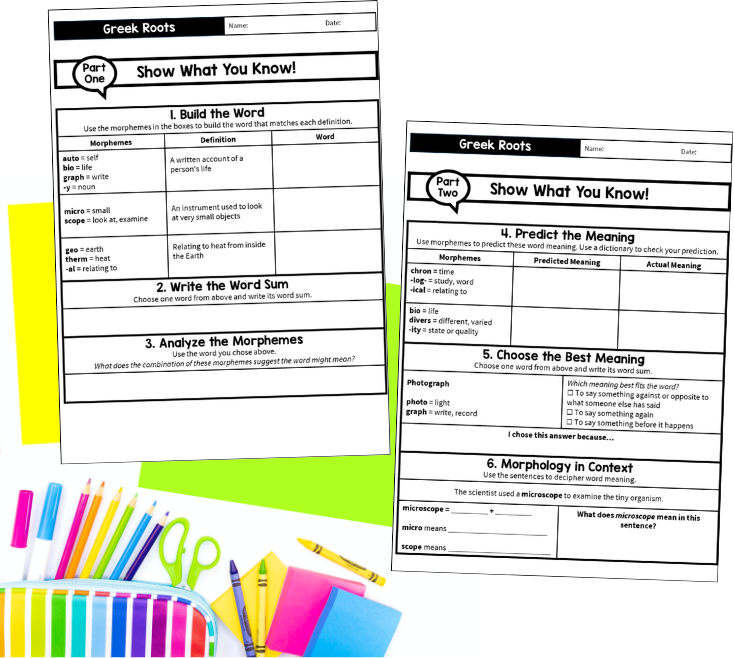
Students often tell you that un- means not, -ful means full of, and tele- relates to distance. This is a good start to morphology practice.
However, when that student meets word unhelpful or telecommunication in science text, deeper morphology practice explains why useful knowledge may disappear.
This is a common challenge. However, recognition is only one part of morphology instruction.
The real goal is for students to use word structure to work out meaning and notice connections between words. The good news is that morphology practice does not need to become another isolated worksheet routine.
Here are five ways to connect morphology practice to vocabulary activities and authentic reading.
1. Start with words from the texts students are reading
Instead of choosing morphemes first and searching for words to match them, begin with the words students actually need to understand. Look through an upcoming class novel, history article, science explanation, or short story and collect a small group of words that contain meaningful parts.
For example, a science text might include:
- predictable
- ecosystem
- photosynthesis
- reusable
- microscopic
You do not need to analyze every long word on the page. Choose two or three that are important to the text and useful beyond that one lesson. Then invite students to practice morphology skills by examining the word structure and connect it to the surrounding sentence.
For predictable, students might identify predict as the base and -able as a suffix meaning able to be. They can then use morphology practice skills to explain that predictable describes something that can be predicted. The important step is to check that explanation against the sentence. If the text says, The movement of the planet is predictable, the context confirms their thinking.
This approach helps students see morphology as a reading tool rather than a collection of word parts to memorize. It also gives you a natural opportunity to discuss cases where a word cannot be understood by simply adding the meanings of its parts. A student may notice that a particular word seems to fit a pattern but does not make sense in context. That is a valuable reminder that morphology offers clues, not magic answers.
2. Use a morphology practice detective routine
A consistent routine can make morphology practice less daunting, especially for students who need a clear process. When students meet an unfamiliar word, ask them to work through four questions:
1. What meaningful parts can you spot?
2. What does each part suggest?
3. What might the whole word mean?
4. Does that meaning fit the sentence or paragraph?

Try this with the word disagreement. Students might identify dis-, agree, and -ment. They can discuss how dis- changes the meaning, how agree acts as the base, and how -ment creates a noun connected to an action or result. They could then explain the word in a sentence such as, Their disagreement continued throughout the meeting.
The final question matters most in morphology practice. Students should not stop after splitting the word into parts. Ask them to use the word in context, find a synonym, or replace it with a simpler phrase. For example, disagreement might become a situation in which people do not agree. If the replacement makes sense in the sentence, students have stronger evidence that their interpretation is reasonable.
You can model the routine aloud at first, gradually moving responsibility to pairs and then individual readers. A small morphology practice notebook or a shared class chart can help students record interesting words, possible meanings, and the context that confirmed or changed their thinking.
3. Build word families for morphology practice
A list of prefixes and suffixes can be useful, but students often remember word families more easily when they can see how words are related. Choose a base word or root and create a word web showing several connected forms.
For the base spect, meaning to look or see, students might explore inspect, spectator, respect, spectacle, and perspective. This is also a good opportunity to discuss how the meaning of a root can shift slightly across different words. Respect does not simply mean to look again in everyday use, so students need to consider the word’s history and current meaning rather than forcing every word into one neat formula.
A more transparent example could be the base act:
- act
- action
- active
- activate
- inactive
- react
- interaction
Ask students to sort the words by part of speech, explain how prefixes or suffixes affect meaning, and write a short paragraph using several members of the family. They might write about an interaction in which one person reacted to an active suggestion.

Word-family work supports vocabulary growth because students are not meeting each word as a completely separate item. It also encourages students to notice patterns while reading independently. Keep the discussion focused on meaning and use, not just how many words students can generate. A very long list is less useful than a smaller group of words students can explain accurately.
4. Make students explain their reasoning to one another
Morphology becomes more meaningful when students have to justify an interpretation. Partner talk is particularly useful here because it gives students a chance to test an idea before sharing it with the whole class.
Give pairs a sentence containing an unfamiliar or less familiar word. For example:
The town introduced a biodegradable packaging option to reduce waste.
One student might suggest that bio- relates to life and degradable relates to breaking down. The other student can ask whether that meaning fits the sentence. Together, they can create a student-friendly explanation: packaging that can break down naturally through living processes.
You can provide sentence stems such as:
- I think the word means ___ because ___
- The prefix or root suggests ___
- This fits the sentence because ___
- I am unsure about ___, so I would check ___
These stems are helpful for students who understand the word parts but find it difficult to articulate their thinking. They also make room for uncertainty, which is important. Strong readers do not always know a word immediately; they gather clues, make a tentative meaning, and revise it when necessary.

To keep the activity focused, ask students to point to evidence in the word and the surrounding text. That small expectation can prevent morphology discussions from turning into imaginative guesses based on one familiar prefix.
5. Transfer morphology into writing and word choice
Students are more likely to apply morphology independently when they use it to make choices in their own writing. After exploring a group of related words, give them a short writing task that requires precise vocabulary.
Suppose the class has studied words connected to the root port, meaning carry. Students might know transport, portable, import, export, and support. Ask them to write a paragraph explaining how goods move between countries, or to describe a character who supports a friend through a difficult journey. Then invite them to underline words whose meanings are connected to the root and explain how each word works in context.

Another option is a word-choice revision task. Give students a sentence such as, The rule made the process better, and ask them to replace better with a more precise word from a word family they have studied. Depending on the context, they might choose more efficient, safer, or more manageable. Discussing why one choice is more suitable than another links morphology to register, nuance, and writing style.
You can also ask students to create a short vocabulary entry for a word they have encountered in their reading. It might include the word’s morphemes, a student-friendly definition, an example sentence, and a related word. This is more valuable than copying a dictionary definition because students must show how the word behaves in real language.
Keep morphology connected to meaning
Effective morphology activities do not need to be long or complicated. A five-minute discussion about one important word in a class text may be more useful than a page of disconnected word-part exercises. The key is to move students beyond spotting morphemes and towards using them as evidence.

Choose words from meaningful reading, ask students to explain their reasoning, check interpretations against context, and provide regular opportunities to use related words in speaking and writing.
Over time, students can begin to approach unfamiliar vocabulary with curiosity rather than immediate defeat. They may not decode every word perfectly, but they will have a practical strategy for getting closer to meaning. That is the kind of morphology knowledge that travels with them from one text to the next.

Morphology resources at The Wordsmith Cat on Teachers Pay Teachers.

Printed and bound workbooks at Amazon Kindle Direct Publishing.